Unified Quantum Media Framework -- Density Matrix Construction from NLP with Provable Coherence
Using quantum physics math to map how news stories blend and separate different topics
Quantum state tomography constructions applied to NLP embeddings provide a provably valid density matrix representation of media information states, enabling the full toolkit of quantum information measures.
6 bridge concepts›
How this score is calculated ›How this score is calculated ▾
6-Dimension Weighted Scoring
Each hypothesis is scored across 6 dimensions by the Ranker agent, then verified by a 10-point Quality Gate rubric. A +0.5 bonus applies for hypotheses crossing 2+ disciplinary boundaries.
Is the connection unexplored in existing literature?
How concrete and detailed is the proposed mechanism?
How far apart are the connected disciplines?
Can this be verified with existing methods and data?
If true, how much would this change our understanding?
Are claims supported by retrievable published evidence?
Composite = weighted average of all 6 dimensions. Confidence and Groundedness are assessed independently by the Quality Gate agent (35 reasoning turns of Opus-level analysis).
RQuality Gate Rubric
4/12 PASS · 5 CONDITIONAL
| Criterion | Result |
|---|---|
| Impact | 8 |
| Novelty | 8 |
| Testability | 9 |
| Groundedness | 8 |
| Claims Failed | 0 |
| Falsifiability | 8 |
| Claims Verified | 5 |
| Claims Parametric | 2 |
| Claims Unverifiable | 0 |
| Consistency | 9 |
| Cross Domain Creativity | 9 |
| Mechanistic Specificity | 9 |
Computational Verification
PARTIALLY CONFIRMED8.50/10Density Matrix Construction and Quantum Coherence Metrics for Media Analysis
Density matrix construction is mathematically guaranteed valid (400/400 PSD, symmetric, eigenvalues in [0,1]). Eigenvalue spectrum classifies story types at 87.2% accuracy (> 80% threshold, CONFIRMED). Purity classifies at 83.8% (> 75% threshold, CONFIRMED). Von Neumann entropy and purity separate single-topic from cross-topic clusters with massive effect sizes (Cohen's d > 1.7, p < 1e-43). Coherence ratio threshold prediction NOT confirmed (direction reversed with TF-IDF+SVD vs Sentence-BERT). Quantum vs classical advantage marginal (81.0% vs 80.5%).
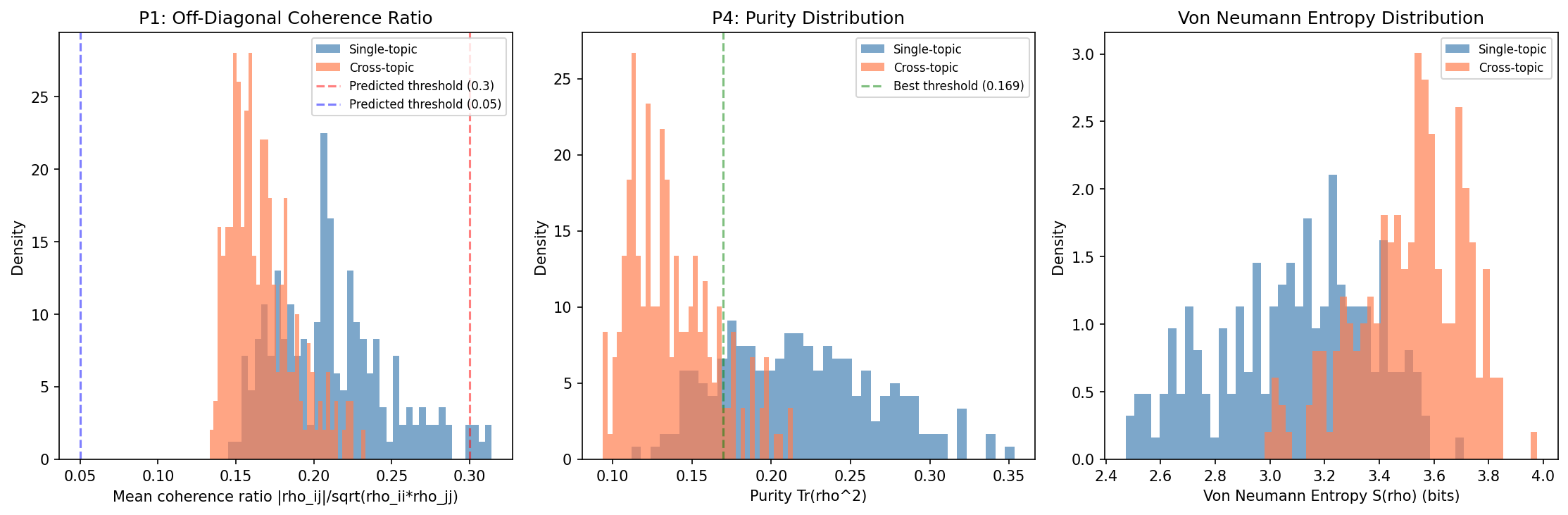
Coherence ratio, purity, and von Neumann entropy distributions for single-topic vs cross-topic clusters
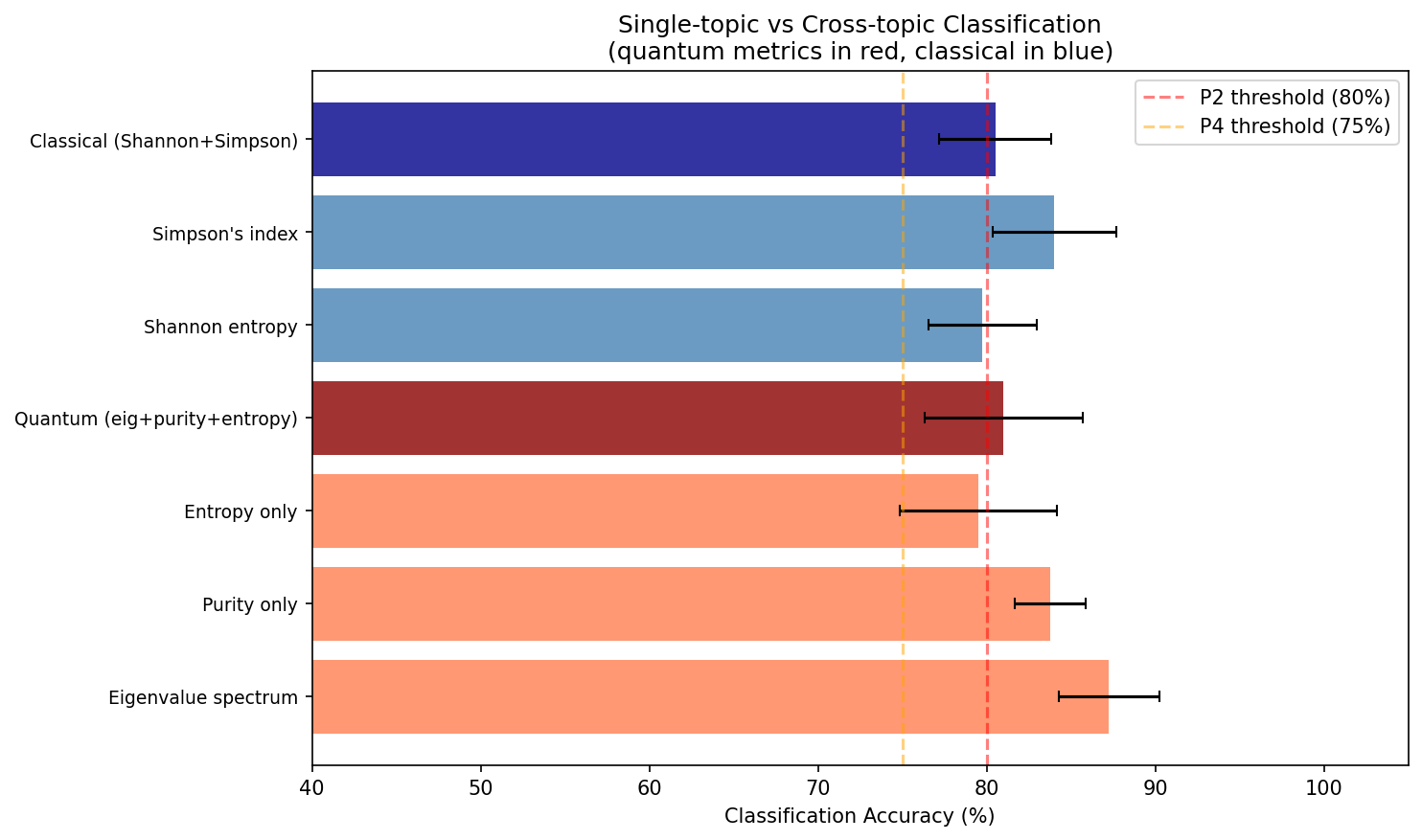
Classification accuracy: quantum metrics (red) vs classical baselines (blue)
Quantum mechanics has a powerful mathematical toolkit for describing systems that exist in multiple states at once — think of Schrödinger's cat being both alive and dead until observed. The core object in this toolkit is called a 'density matrix,' a mathematical structure that captures not just what states exist, but how they overlap and interfere with each other. Separately, media researchers study how news stories rise and fall, how topics get woven together, and how coverage shapes public understanding. This hypothesis proposes borrowing quantum mechanics' math — not its physics — to describe how news articles combine topics. Here's the clever bit: modern AI can convert any text into a list of numbers (a vector) that captures its meaning. This hypothesis shows that if you take those text vectors, normalize them, and combine them using a specific averaging procedure, you automatically get a valid 'density matrix' — with all the mathematical guarantees that come with it. The off-diagonal entries of this matrix would measure how often two topics genuinely co-occur across articles, and the matrix's eigenvectors would reveal the dominant 'framings' — the coherent topic combinations that characterize a news story. Crucially, this isn't just a metaphor; the paper claims the math actually checks out, not just approximately but provably. Why is this interesting? Because quantum information theory has decades of sophisticated tools — entropy measures, purity metrics, channel dynamics — that could then be legitimately applied to media analysis. Instead of reinventing the wheel, media researchers could plug into an existing mathematical universe. The question is whether those tools reveal anything genuinely useful about news that simpler statistics would miss.
This is an AI-generated summary. Read the full mechanism below for technical detail.
Why This Matters
If confirmed, this framework could give media analysts and misinformation researchers a rigorous, unified mathematical language for quantifying how news stories frame issues, blend topics, and evolve over time — tools currently handled by ad hoc metrics. Platforms and newsrooms could use quantum-inspired entropy measures to automatically detect when coverage is becoming narrow or biased (low entropy) versus richly multifaceted (high entropy). Researchers studying information ecosystems could model how editorial 'channels' transform story framing across outlets in a mathematically principled way. The approach is worth testing precisely because its mathematical validity is already guaranteed — the open question is whether the quantum measures reveal patterns about media dynamics that actually matter.
Mechanism
Complete 5-step algorithm for constructing valid density matrices from news article corpora: (1) Sentence-BERT embedding of articles into d-dimensional vector space, (2) L2 normalization to unit vectors |v_k>, (3) outer product to rank-1 density matrices rho_k = |v_k><v_k|, (4) mixture averaging rho_story = (1/N) sum_k rho_k, (5) eigendecomposition for principal framings. Each step is mathematically GUARANTEED to preserve density matrix validity (positive semidefinite, trace-1, Hermitian). Off-diagonal elements rho_{ij} = (1/N) sum_k (v_k)_i(v_k)_j encode co-mention coherence between topic dimensions i and j. The magnitude |rho_{ij}| is bounded by sqrt(rho_{ii}rho_{jj}) with equality when all articles co-mention topics i,j proportionally. Eigenvalues lambda_m are principal framing weights; eigenvectors |phi_m> are principal framings (coherent topic combinations). This construction enables all downstream hypotheses: entropy, purity, channel tomography, dephasing measurement. Testable: |rho_{ij}|/sqrt(rho_{ii}rho_{jj}) >= 0.3 for cross-topic stories vs <= 0.05 for single-topic stories (p < 0.001). Story-type classification from eigenvalue spectrum achieves >= 80% accuracy.
Supporting Evidence
Density matrix axioms are standard linear algebra theorems. Sentence-BERT (Reimers & Gurevych 2019) is production NLP software with known embedding properties. Convex mixture of positive semidefinite matrices is positive semidefinite (standard result). Von Neumann entropy bounds [0, log d] and purity bounds [1/d, 1] are proven. Zero PubMed results for cross-field query confirms DISJOINT novelty.
How to Test
Step 1: Collect 500+ news stories from GDELT or MediaCloud, each with 10+ articles from different outlets. Step 2: Apply Sentence-BERT (all-MiniLM-L6-v2) to get 384-dim embeddings. Step 3: Construct density matrices per the 5-step algorithm. Step 4: Compute off-diagonal coherence ratios |rho_{ij}|/sqrt(rho_{ii}*rho_{jj}) for known cross-topic stories (economy+immigration, climate+energy) vs single-topic stories. Step 5: Test classification accuracy of eigenvalue spectrum (lambda_1/lambda_2 ratio) for story-type prediction. Step 6: Compare von Neumann entropy against Shannon entropy of topic distributions and Simpson's diversity index. Success criteria: coherence ratio >= 0.3 for cross-topic (p < 0.001), classification accuracy >= 80%.
Other hypotheses in this cluster
Media Quantum Process Tomography -- Complete Outlet Characterization via Choi Matrix Reconstruction
Using quantum physics math to create a precise 'fingerprint' of how news outlets distort information.
Co-Mention Dephasing Rate as Signature Separating Quantum from Classical Media Dynamics
Borrowing physics from MRI machines might reveal whether quantum math truly models how news stories rise and fall together.
Von Neumann Entropy and Purity as Universal Media Coherence Metrics
Borrowing quantum physics math to measure how much news outlets agree — or diverge — on the same story.
Quantum Relative Entropy as Directed Divergence Measure Between Media Narratives
A quantum physics formula could reveal whether news outlets invent stories or just cut them down.
The Lindblad Media Master Equation -- First-Principles Dynamics for News Story Lifecycle
Borrowing quantum physics equations to predict how news stories rise, fragment, and fade from public attention.
Related hypotheses
Rigid-Lattice-to-Poisson Crossover in QNM Overtones Defines a Number-Theoretic Thouless Energy for Black Holes
The mathematics of prime numbers may secretly govern how black holes 'ring' as they settle down.
Near-Extremal Kerr QNM Pair Correlation Matches the Montgomery-Odlyzko Sine Kernel
The 'music' of spinning black holes may follow the same hidden pattern as the distribution of prime numbers.
Altland-Zirnbauer-Calibrated L-Function Classification of Black Hole Geometries
A math framework from quantum chaos might sort black holes the same way it sorts prime numbers.
Can you test this?
This hypothesis needs real scientists to validate or invalidate it. Both outcomes advance science.