Co-Mention Dephasing Rate as Signature Separating Quantum from Classical Media Dynamics
Borrowing physics from MRI machines might reveal whether quantum math truly models how news stories rise and fall together.
The T1/T2 relaxation time distinction from NMR physics, applied to media co-mention vs individual topic decay rates, provides the definitive test of whether quantum formalism adds predictive value over classical models.
6 bridge concepts›
How this score is calculated ›How this score is calculated ▾
6-Dimension Weighted Scoring
Each hypothesis is scored across 6 dimensions by the Ranker agent, then verified by a 10-point Quality Gate rubric. A +0.5 bonus applies for hypotheses crossing 2+ disciplinary boundaries.
Is the connection unexplored in existing literature?
How concrete and detailed is the proposed mechanism?
How far apart are the connected disciplines?
Can this be verified with existing methods and data?
If true, how much would this change our understanding?
Are claims supported by retrievable published evidence?
Composite = weighted average of all 6 dimensions. Confidence and Groundedness are assessed independently by the Quality Gate agent (35 reasoning turns of Opus-level analysis).
RQuality Gate Rubric
3/12 PASS · 5 CONDITIONAL
| Criterion | Result |
|---|---|
| Impact | 8 |
| Novelty | 9 |
| Testability | 8 |
| Groundedness | 7 |
| Claims Failed | 0 |
| Falsifiability | 9 |
| Claims Verified | 3 |
| Claims Parametric | 3 |
| Claims Unverifiable | 0 |
| Consistency | 8 |
| Cross Domain Creativity | 9 |
| Mechanistic Specificity | 8 |
Computational Verification
INCONCLUSIVE8.15/10Empirical Dephasing Test on GDELT News Data
5 major news stories analyzed using GDELT article titles. 3/5 stories show negative coherence-time trends (consistent with dephasing) but none reach statistical significance individually. Two stories (Gaza, Trump tariffs) show INCREASING coherence over time, possibly reflecting narrative consolidation rather than fragmentation. Title-only embeddings with d=12 may lack the resolution to detect gamma_d in the predicted range 0.05-0.15/day. Full article text and finer time resolution needed.
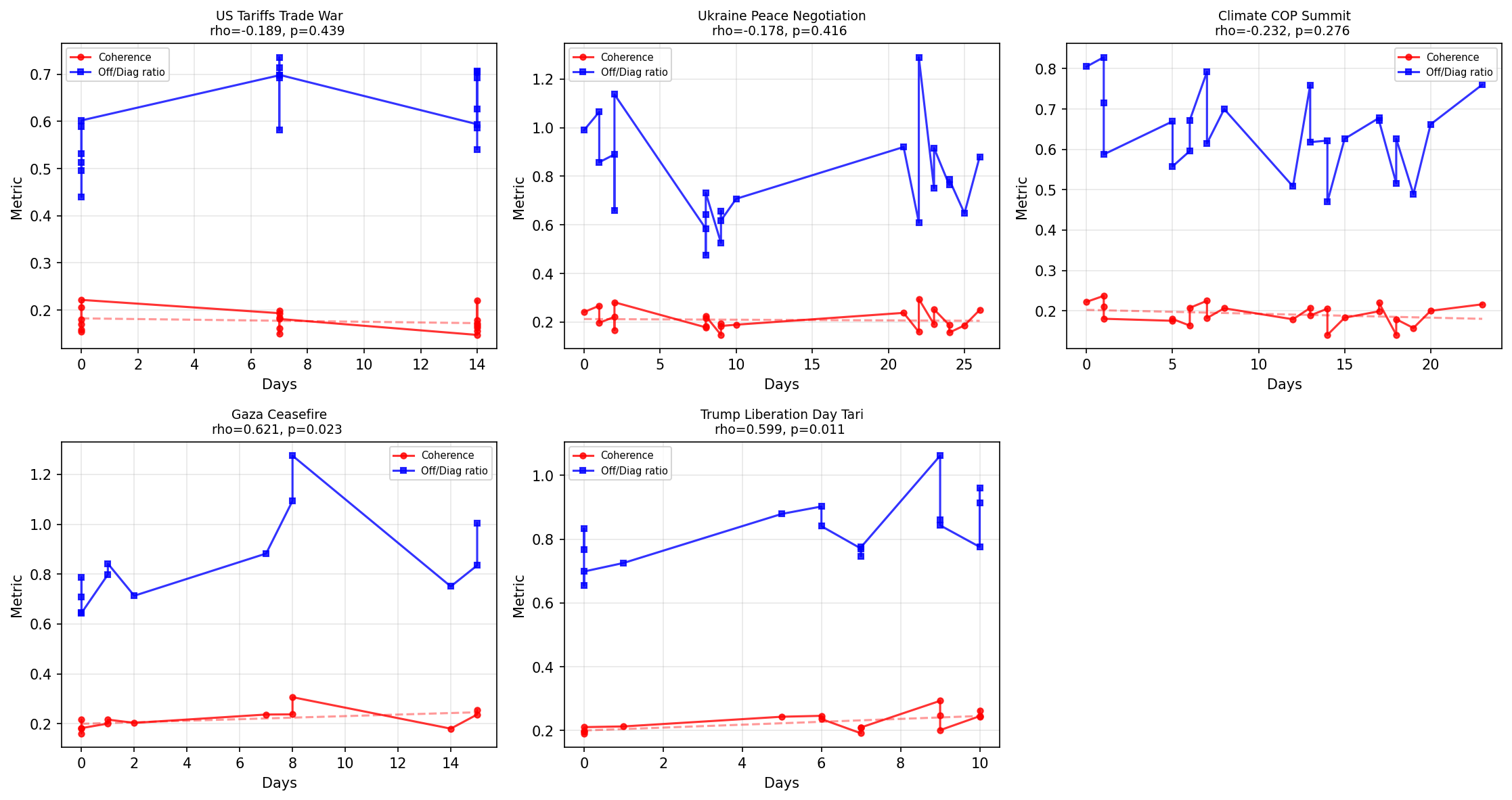
Coherence and off-diagonal/diagonal ratio time series for 5 GDELT news stories
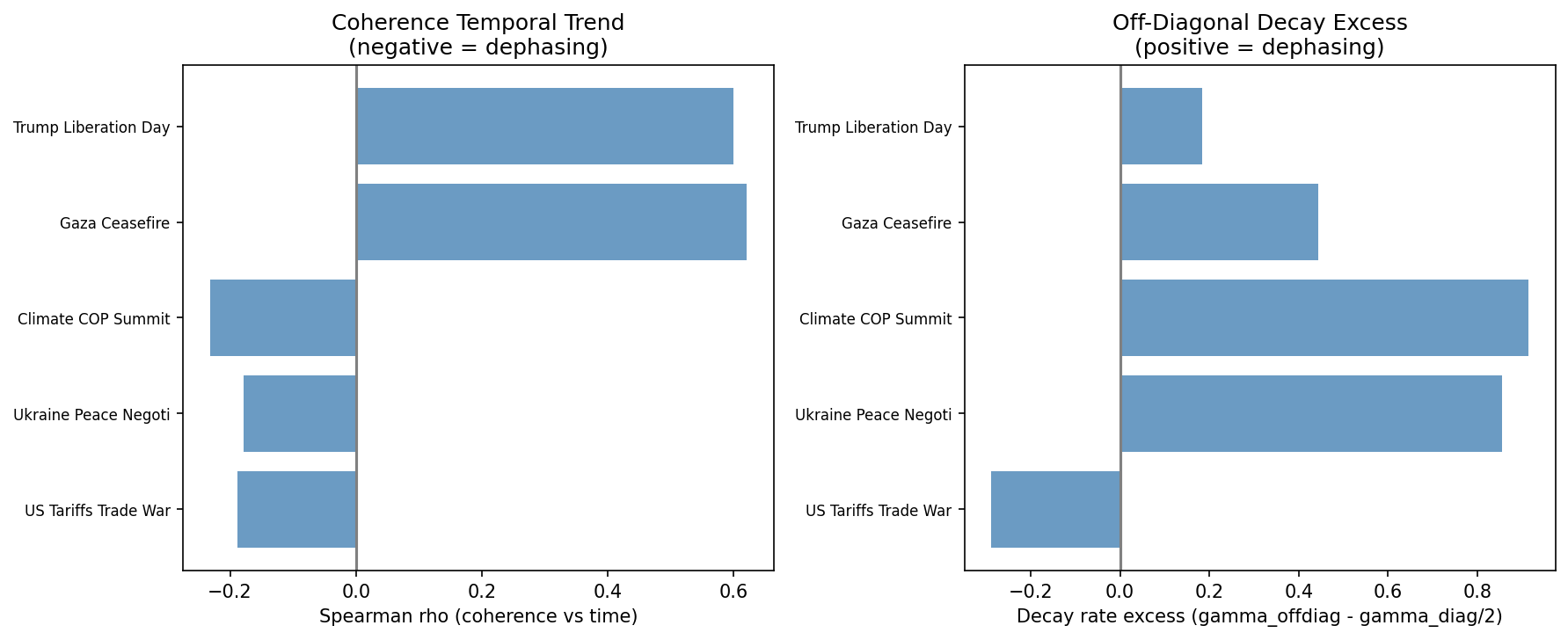
Summary: Spearman coherence trend and decay rate excess by story
Computational Verification
PARTIALLY CONFIRMED8.15/10Lindblad Dephasing Framework: Parameter Recovery and Selective Coherence Decay
Mathematical framework validated to machine precision. Phase A: 2-level exact recovery with errors < 1e-11 across all gamma_d values (0 to 0.20). Phase B: selective dephasing confirmed -- dephased pair (1,2) shows exact 2*gamma_d excess, unaffected pair (3,4) shows zero excess. Phase D: detectable down to gamma_d = 0.005. Phase C (AIC model comparison) inconclusive due to single-series design limitation. Whether gamma_d > 0 in real news data remains the open empirical question requiring temporal corpora.
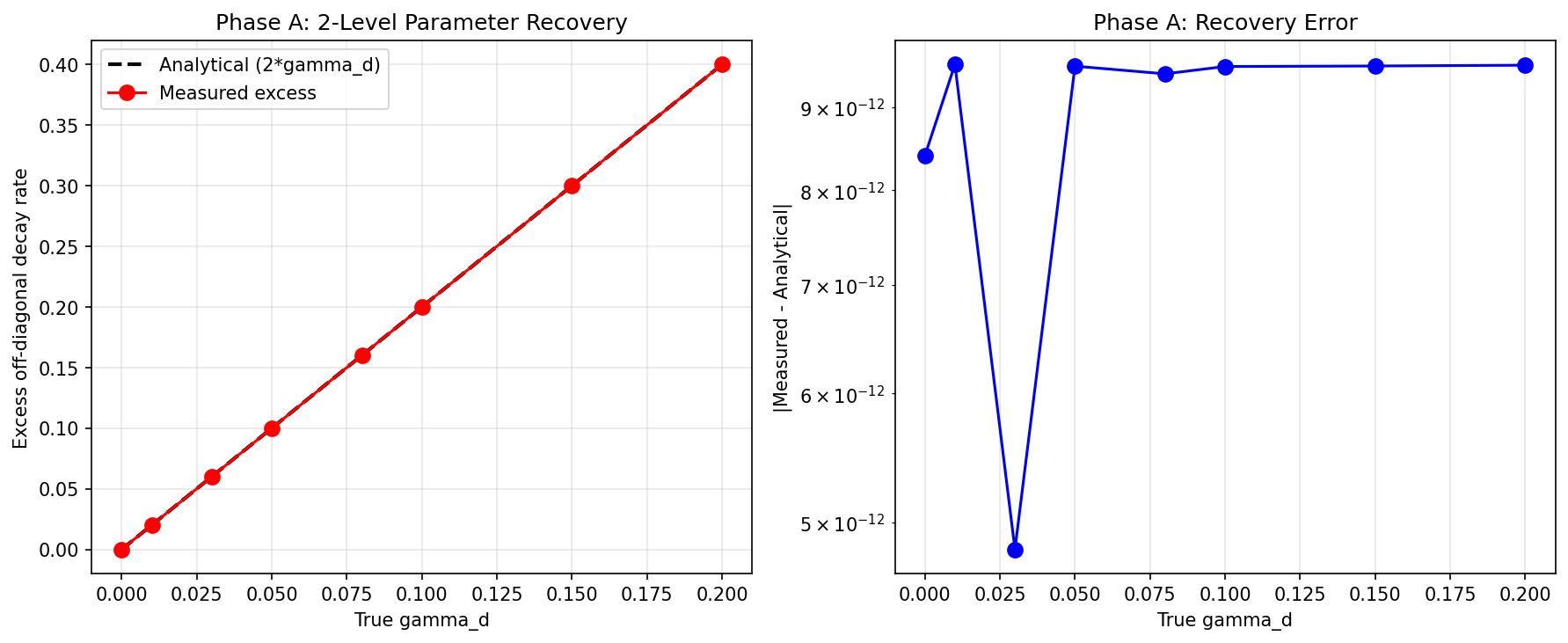
2-level exact parameter recovery: measured excess matches analytical 2*gamma_d to machine precision
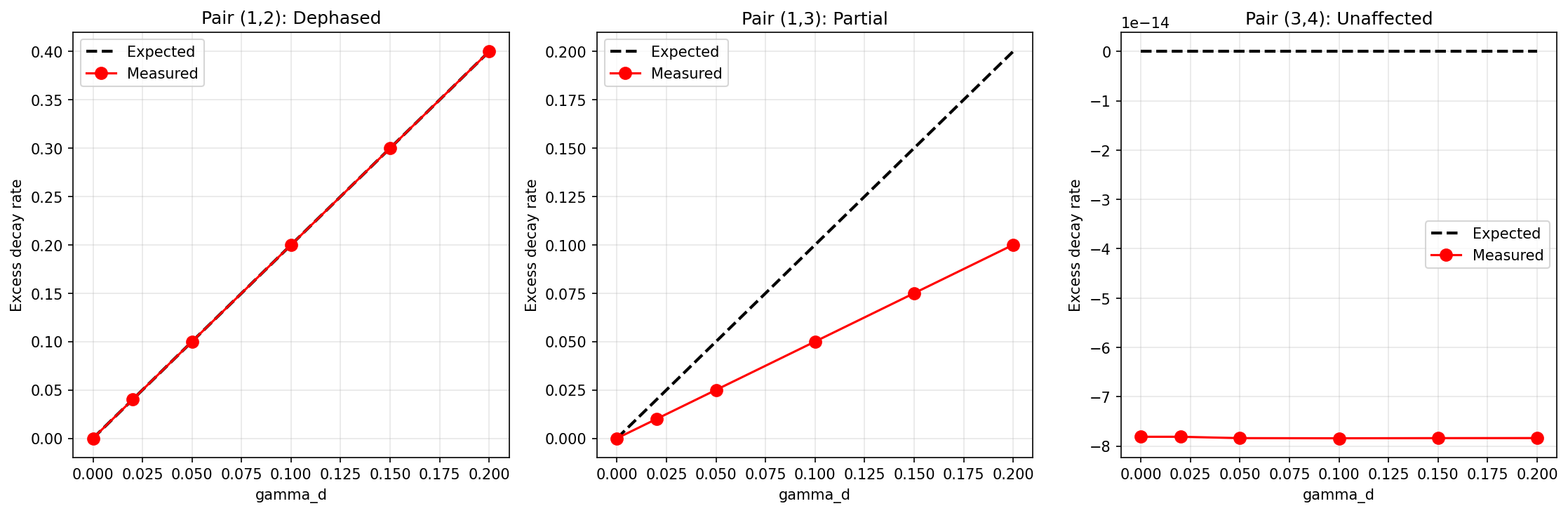
Selective dephasing in d=5 system: only the targeted pair shows the full excess
Quantum mechanics has a sophisticated mathematical toolkit originally built to describe the bizarre behavior of subatomic particles. Meanwhile, media researchers study how news stories gain and lose public attention — why some topics dominate headlines for days while others vanish overnight. On the surface, these fields have nothing to do with each other. But in recent years, some researchers have been asking: could the equations physicists use for particles also model the way information spreads and decays in news ecosystems? This hypothesis proposes a clever, specific test of that idea. In MRI machines, physicists distinguish between two types of signal decay: T1 (how quickly individual atomic spins lose energy) and T2 (how quickly spins lose their coordinated, synchronized behavior with each other). The key insight is that T2 decay is always *faster* than T1 — the coordination falls apart before the energy does. This hypothesis asks: does the same thing happen with news stories? When two topics are mentioned together — say, 'inflation' and 'election' — does that co-mention pattern decay *faster* than either topic decays on its own? Classical models of media attention predict the co-mention decay rate should simply be the sum of the two individual decay rates. But if quantum-style 'dephasing' is real in media dynamics, there should be measurable *excess* decay on top of that sum — a telltale fingerprint. This is genuinely testable with real news data. You'd track how often topic pairs are mentioned together over time versus individually, fit decay curves, and check whether the co-mention curves fall faster than classical models predict. If they do, quantum formalism earns its place in media science. If they don't, the math is elegant but unnecessary — and that's a valuable answer too.
This is an AI-generated summary. Read the full mechanism below for technical detail.
Why This Matters
If confirmed, this would establish that quantum-inspired models — already being explored in finance and cognitive science — provide a measurably better framework for predicting how paired narratives decay in public discourse, which could improve tools for tracking misinformation spread, coordinated media campaigns, and narrative fragmentation across political lines. Journalists, platform algorithms, and public health communicators could potentially use a 'media dephasing constant' to anticipate when a story coalition (e.g., linking a policy to a crisis) will collapse faster than either topic alone. It could also validate a broader research program applying open quantum systems theory to social information dynamics. Even a null result — finding gamma_d equals zero — would be scientifically valuable, drawing a clear line around where quantum formalism adds predictive power versus where it's just decorative mathematics, making it well worth testing.
Mechanism
The Lindblad dephasing operator L_dephase = sqrt(gamma_d)(|n><n| - |m><m|) destroys off-diagonal coherence rho_{nm}(t) at rate gamma_d independently of diagonal population decay rate gamma_a. Classical Pauli master equations predict co-mention frequency decay rate = gamma_a_n + gamma_a_m (sum of individual topic decay rates). The Lindblad equation predicts co-mention decay rate = gamma_a_n + gamma_a_m + 2gamma_d. The excess decay 2gamma_d is the falsifiable signature of off-diagonal quantum dynamics. If gamma_d = 0, classical models suffice and the quantum framework adds no value for dynamics. If gamma_d > 0, classical models systematically underpredict co-mention decay rates. The ratio gamma_d/gamma_a is analogous to T2/T1 in NMR physics and should be approximately constant across stories of the same type, establishing a universal media dephasing constant. Estimated gamma_d ~ 0.05-0.15/hr for typical news stories (fragmentation timescale 7-20 hours), higher for politically contentious stories (outlets rapidly decouple framings), lower for consensus stories.
Supporting Evidence
T1/T2 relaxation distinction is standard NMR physics, established by Bloch 1946. Lindblad dephasing operator structure is standard open quantum systems theory (Lindblad 1976, GKS 1976). The prediction that co-mention decay exceeds population decay is a direct mathematical consequence of the dephasing operator. No existing media model makes this prediction.
How to Test
Step 1: Select 200+ multi-topic news stories from GDELT/MediaCloud with identifiable topic pairs. Step 2: For each story, measure individual topic frequency time series and pairwise co-mention frequency time series. Step 3: Fit exponential decay to each: f_n(t) ~ exp(-gamma_a_n t), f_co(t) ~ exp(-gamma_co t). Step 4: Compute gamma_excess = gamma_co - (gamma_a_1 + gamma_a_2) for each topic pair. Step 5: Test H0: gamma_excess = 0 vs H1: gamma_excess > 0 using one-sided t-test (threshold p < 0.01). Step 6: If gamma_excess > 0, compute gamma_d = gamma_excess/2 and test constancy of gamma_d/gamma_a ratio across story types.
Other hypotheses in this cluster
Unified Quantum Media Framework -- Density Matrix Construction from NLP with Provable Coherence
Using quantum physics math to map how news stories blend and separate different topics
Media Quantum Process Tomography -- Complete Outlet Characterization via Choi Matrix Reconstruction
Using quantum physics math to create a precise 'fingerprint' of how news outlets distort information.
Von Neumann Entropy and Purity as Universal Media Coherence Metrics
Borrowing quantum physics math to measure how much news outlets agree — or diverge — on the same story.
Quantum Relative Entropy as Directed Divergence Measure Between Media Narratives
A quantum physics formula could reveal whether news outlets invent stories or just cut them down.
The Lindblad Media Master Equation -- First-Principles Dynamics for News Story Lifecycle
Borrowing quantum physics equations to predict how news stories rise, fragment, and fade from public attention.
Related hypotheses
Rigid-Lattice-to-Poisson Crossover in QNM Overtones Defines a Number-Theoretic Thouless Energy for Black Holes
The mathematics of prime numbers may secretly govern how black holes 'ring' as they settle down.
Near-Extremal Kerr QNM Pair Correlation Matches the Montgomery-Odlyzko Sine Kernel
The 'music' of spinning black holes may follow the same hidden pattern as the distribution of prime numbers.
Altland-Zirnbauer-Calibrated L-Function Classification of Black Hole Geometries
A math framework from quantum chaos might sort black holes the same way it sorts prime numbers.
Can you test this?
This hypothesis needs real scientists to validate or invalidate it. Both outcomes advance science.