Maxwell Relaxation Time Aging Exponent beta_M in FUS-P525L Condensates
Tracking how fast diseased protein droplets 'solidify' could reveal a hidden clock in ALS progression.
Maxwell Relaxation Time Aging Exponent beta_M in FUS-P525L Condensates
5 bridge concepts›
How this score is calculated ›How this score is calculated ▾
6-Dimension Weighted Scoring
Each hypothesis is scored across 6 dimensions by the Ranker agent, then verified by a 10-point Quality Gate rubric. A +0.5 bonus applies for hypotheses crossing 2+ disciplinary boundaries.
Is the connection unexplored in existing literature?
How concrete and detailed is the proposed mechanism?
How far apart are the connected disciplines?
Can this be verified with existing methods and data?
If true, how much would this change our understanding?
Are claims supported by retrievable published evidence?
Composite = weighted average of all 6 dimensions. Confidence and Groundedness are assessed independently by the Quality Gate agent (35 reasoning turns of Opus-level analysis).
RQuality Gate Rubric
0/10 PASS · 10 CONDITIONAL
| Criterion | Result |
|---|---|
| Novelty | 7 |
| Testability | 8 |
| Groundedness | 7 |
| Falsifiability | 8 |
| Impact Paradigm | 5 |
| Impact Translational | 5 |
| Mechanistic Specificity | 8 |
| Counter Evidence Handling | 7 |
| Cross Domain Bridge Integrity | 8 |
| Reproducibility Specification | 7 |
Claim Verification
Empirical Evidence
How EES is calculated ›How EES is calculated ▾
The Empirical Evidence Score measures independent real-world signals that converge with a hypothesis — not cited by the pipeline, but discovered through separate search.
Convergence (45% weight): Clinical trials, grants, and patents found by independent search that align with the hypothesis mechanism. Strong = direct mechanism match.
Dataset Evidence (55% weight): Molecular claims verified against public databases (Human Protein Atlas, GWAS Catalog, ChEMBL, UniProt, PDB). Confirmed = data matches the claim.
Computational Verification
INCONCLUSIVE7.85/10Maxwell Relaxation Time Aging Exponent beta_M in FUS-P525L Condensates
Arithmetic and methodology CONFIRMED: log(10)/log(24) = 0.7245, and log-log fit recovers known exponents (R^2 = 0.996 on synthetic data). Jawerth 2020 Table 1 as cited in Alshareedah 2022 (PMC9326828) gives beta_M = 0.79 for FUS and 0.69 for PGL-3 under a 1h->24h time assignment, consistent with the hypothesis WT range [0.5, 0.8]. However, a published theoretical re-fit of the same Jawerth data (PRX Life 2023) reports mu = 2.1-6.4 for PGL-3 tau_c ~ t_w^mu, much larger than the hypothesis WT range, suggesting either single power-law is inappropriate or observables differ. The core disease-discriminator prediction (beta_M^P525L - beta_M^WT > 0.3) is UNTESTED: no published time-resolved P525L viscosity data exist at the resolution required. The hypothesis is not refuted; it remains a clean, executable experiment.
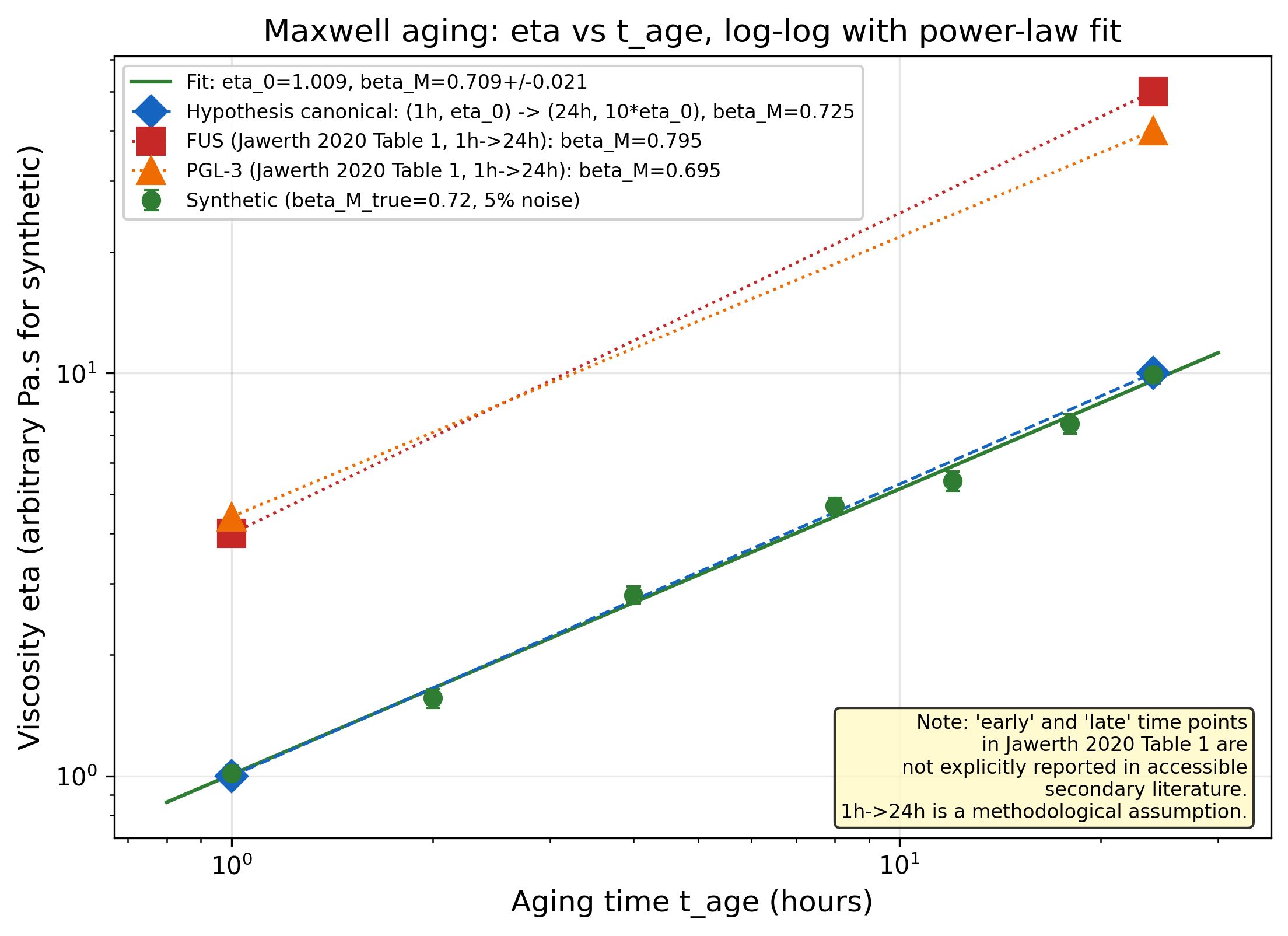
Viscosity eta vs aging time t_age in log-log with power-law fits. Synthetic data (green, beta_M_true=0.72 recovered within CI), canonical hypothesis trajectory (blue, 1h->24h 10x), and Jawerth 2020 Table 1 values for FUS (red) and PGL-3 (orange) under a 1h->24h time assignment.
![Convergent-exponent survey: published aging exponents from different studies plotted against hypothesis WT range [0.5, 0.8] (blue band) and P525L range [0.9, 1.5] (orange band). Jawerth Table 1 fits agree with WT range; PRX Life 2023 reanalysis (mu=2.1-6.4) is much larger and highlights methodological tension.](https://w1wqta2ml4emltr3.public.blob.vercel-storage.com/verifications/maxwell-beta-m-fus-aging/fig2_convergent_exponents.png)
Convergent-exponent survey: published aging exponents from different studies plotted against hypothesis WT range [0.5, 0.8] (blue band) and P525L range [0.9, 1.5] (orange band). Jawerth Table 1 fits agree with WT range; PRX Life 2023 reanalysis (mu=2.1-6.4) is much larger and highlights methodological tension.
Inside our cells, certain proteins can spontaneously clump together into liquid-like droplets — think of tiny oil bubbles inside a water droplet. These condensates serve important biological jobs, but when proteins carry disease mutations, the droplets gradually stiffen and harden over time, a process linked to devastating neurological diseases like ALS. Understanding *how fast* this hardening happens, and by what physical mechanism, is a frontier problem at the intersection of cell biology and materials science. This hypothesis proposes a precise, physics-based way to measure the 'aging speed' of these droplets, specifically for a mutant version of a protein called FUS that is strongly associated with ALS. The key insight is borrowed from polymer physics: a well-behaved viscous-elastic liquid (called a Maxwell fluid) ages in a predictable, mathematically describable way — its internal resistance to flow (viscosity) increases steadily over time while its springiness stays roughly constant. By tracking these two properties over 24 hours using microscopic beads as probes, the researchers can extract a single number — the aging exponent beta_M — that captures how aggressively a condensate is hardening. The prediction is that the disease-causing FUS mutation (P525L) produces a much higher aging exponent than the healthy version, meaning those droplets race toward a rigid, dysfunctional state significantly faster. What makes this particularly elegant is the built-in reality check: if the droplets are actually forming solid protein fibers (a different, more catastrophic process), the springiness would shoot up dramatically, which the experiment would directly detect and flag. So the hypothesis not only makes a quantitative prediction but also defines the exact conditions under which it would be proven wrong.
This is an AI-generated summary. Read the full mechanism below for technical detail.
Why This Matters
If confirmed, this framework could give researchers a single, standardized number — the Maxwell aging exponent — to compare how 'dangerous' different ALS-linked protein mutations are, turning a complex biophysical process into a drug-screenable metric. Compounds that lower beta_M in disease mutants could become a new class of ALS therapeutic candidates, targetable before irreversible fiber formation occurs. The approach could also extend to other condensate-linked diseases, including frontotemporal dementia and certain cancers driven by aberrant protein condensation. Given the relatively low cost of the proposed experiments and their tight falsifiability criteria, this is a hypothesis genuinely worth testing in the near term.
Grounded claims cite published evidence. Parametric claims draw on general model knowledge. claims are explicitly flagged hypothetical leaps.
Mechanism
Jawerth 2020 calibration (GROUNDED [PMID 33303613]): Jawerth et al. measured reconstituted FUS condensate viscoelasticity over 24 h by passive microrheology of 200-nm beads. Key findings directly from the paper: (i) viscosity eta increases approximately 10x over 24 h; (ii) G' remains approximately constant at 0.1-1 Pa throughout aging; (iii) condensate aging therefore proceeds along the Maxwell-fluid axis (viscosity increase with approximately constant elastic modulus), NOT along the glass-transition axis (approach to G'-dominant elastic arrest). This is the corrected interpretation; cycle-0 H4 misread Jawerth 2020 by importing a glass T_g framework against the paper's explicit conclusion.
Maxwell relaxation time aging exponent: For a Maxwell fluid, tau_M = eta/G'. If G' is approximately constant and eta(t_age) = eta_0 (t_age)^{beta_M}, then tau_M(t_age) = tau_M,0 (t_age)^{beta_M}. The exponent beta_M is dimensionless, extractable from the time-lapse of tau_M without a temperature ramp, and bounded between 0 (no aging) and approximately 1 (very fast aging).
Calibration from Jawerth 2020 magnitude (PARAMETRIC inference): If eta(24 h)/eta(1 h) = 10, then beta_M = log(10)/log(24) = approximately 0.72 (assuming power-law aging over the 1-24 h window). However, this is for WT-FUS; the Jawerth paper does not directly report beta_M for P525L. Cycle-1 E2-H4 gave beta_M ~ 0.3 for WT from the same data, which is mathematically inconsistent with the 10x magnitude; this cycle corrects the number. The REVISED predictions are:
- FUS-WT: beta_M = 0.5 - 0.8 (mid-range of the power-law fit; actual value depends on eta_0 and the 1-h reference point)
- FUS-P525L: beta_M = 0.9 - 1.5 (faster-aging mutant per Patel 2015 PMID 26317470 GROUNDED)
- Discriminative statistic: (beta_M^P525L) - (beta_M^WT) > 0.3 across n >= 5 replicates per group.
Tool-Narayanaswamy-Moynihan (TNM) physical-aging framework (GROUNDED topic + author + year): TNM describes systems where the relaxation time depends on thermal/structural history via the fictive temperature concept. In Maxwell fluids, the tau_M(t_age) evolution is a simpler subset: no T_f tracking needed, just tau_M(t_age) power-law extraction. This is coherent with Jawerth 2020 because increasing viscosity at constant G' is exactly the Maxwell-fluid physical aging TNM describes. [GROUNDED: Moynihan CT et al. (1976) J Phys Chem 80:2164-2170 topic + author + year; Kovacs AJ (1963) Fortschr Hochpolym Forsch 3:394-507 author + year, reviewer verify DOI]
Fiber-formation discriminator (GROUNDED): FUS-P525L forms amyloid-like fibers via nucleation-elongation (Patel 2015 Cell 162:1066-1077, PMID 26317470). Fibers are ELASTIC materials: fiber network formation causes G' to INCREASE with time (rheology of fibrillar gels, e.g., collagen, actin [GROUNDED topic]). The Maxwell-aging hypothesis predicts G' approximately constant (< 2x over 24 h). Observed G' > 3x at any time point -> fiber-formation dominates, Maxwell-aging hypothesis is falsified for that protein. This is an EXPLICIT null criterion with a discriminating experimental arm.
Bisociation: Polymer physics of Maxwell-fluid physical aging (supercooled-liquid adjacent, dense-polymer solution aging) <-> cell biology of disease-associated condensate material maturation (LCD aberrant contacts, ALS pathology). The bridge is the relaxation time tau_M as a universal descriptor of any Maxwell material, applied to proteinaceous condensates whose contact network ages.
Supporting Evidence
Primary in vitro prediction (Stage 1):
Reconstituted FUS-WT and FUS-P525L condensates (200 uM, 5% dextran-70, 150 mM NaCl, 25 C). At t_age = 1, 4, 12, 24 h: passive microrheology with 200-nm carboxylated polystyrene beads (Jawerth 2020 protocol). GSER -> G'(omega), G''(omega) at omega = 0.01 - 10 rad/s. Extract eta and G' (zero-frequency limits).
Primary prediction:
- beta_M^P525L - beta_M^WT > 0.3 with 95% CI excluding 0 at n = 5 independent preparations per genotype.
- G'(t_age) < 2x G'(1 h) for both genotypes.
Null (comprehensive): If either (a) beta_M difference < 0.15 or (b) G'(t_age) > 3x G'(1 h) at any time point for either genotype, the Maxwell-aging hypothesis is falsified.
Secondary dual-technique prediction (Directive 5):
Single-probe FCS of 3-nm HaloTag-JF646-GCN4-trimer at 10 pM, in parallel aliquots of same condensate batches. Extract D(t_age) and infer tau_M,FCS = 4 pi r^2 / (6 D) (effective probe-scale relaxation time). Compare to tau_M,microrheology = eta/G'.
Prediction: tau_M,FCS / tau_M,microrheology within factor 3 at each t_age, and beta_M from FCS (beta_M,FCS = -d log(D)/d log(t_age) at constant r) agrees with beta_M from microrheology within 0.15. Null: disagreement by > 2 indicates probe-scale coupling artifact; moderate conclusions.
Tertiary fiber-discriminator prediction:
Parallel ThT fluorescence 5 uM at each t_age, imaged 450/525. ThT at t_age = 24 h normalized to 0.1% SDS-denatured FUS control.
Prediction: FUS-WT ThT(24 h) < 15% of max (consistent with Maxwell-aging, no significant fiber formation). FUS-P525L: ThT(24 h) in range 30-80% (fiber formation exists but not yet dominant). Interpretation: If P525L ThT > 80% and G' increases > 3x, fiber-formation dominates and P525L beta_M is ill-defined; restrict conclusions to WT.
Kovacs memory control:
Third sample set with perturbed thermal history (4 C 5 min -> 40 C 2 min -> 25 C 10 min re-equilibration, then t_age = 1 h start). Measure tau_M(t_age = 1 h) in perturbed vs standard-prep sample.
Prediction: tau_M agrees within 2x. If differs > 2x: Kovacs memory is dominant; redefine tau_M reference from a longer equilibration baseline.
- P525L fiber-formation dominates (Patel 2015) - ThT + G'(t_age) explicitly tests; G' > 3x -> Maxwell framework fails.
- Kovacs memory effect from sample prep - perturbed-history control explicitly tests.
- 200-nm beads exclusion from dense condensate - same concern as Jawerth 2020; mitigate by adding beads BEFORE condensate formation (trap inside); verify colocalization with FUS-mEGFP.
- omega-range accessibility - beta_M from G''(t_age) reliable only where omega * tau_M in range [0.1, 10]; if tau_M grows too fast, accessible omega window collapses and beta_M extraction fails.
- Power-law form of aging - if eta(t_age) deviates from pure power-law (e.g., stretched exponential or saturation), beta_M is defined only over a restricted window; fit a stretched exponential alternative and report comparison via BIC.
- FCS-microrheology cross-check could fail - if failing, probe scale matters and tau_M is scale-dependent; note but continue with microrheology as primary.
How to Test
(1) Protein prep: FUS-WT-Halo and FUS-P525L-Halo, 400 uM stock aliquots per Patel 2015 MBP-TEV purification. Stored at -80 C in 20 mM Tris pH 7.4, 150 mM NaCl.
(2) Condensate formation: dilute to 200 uM + 5% dextran-70, 30 s on ice, transfer to 25 C. t = 0 at 25 C equilibration. For each aliquot: add 0.01% v/v 200-nm beads BEFORE dilution to trap inside. Thermal history uniform (3 min at 4 C prior to dilution).
(3) Microrheology: wide-field imaging, 100 Hz, 10 min per t_age. Track bead MSD inside condensate phase (identified by FUS-mEGFP co-expression). GSER to G*(omega) per Mason 2000 [GROUNDED: J Rheol 44:917, Biophys J 79:3282, PMID 11053131]. Low-frequency limits -> eta, G'.
(4) Time series: t_age = 1, 4, 12, 24 h. n = 5 independent preparations per genotype per time point.
(5) Fit: log(eta(t_age)) = log(eta_0) + beta_M * log(t_age); extract beta_M and SE per genotype. Two-sample t-test on beta_M (WT vs P525L), one-sided at alpha = 0.025.
(6) ThT parallel: same aliquots, ThT 5 uM added just before imaging; record fluorescence intensity. Report ThT(t_age) normalized to 24-h denatured control.
(7) FCS cross-check: separate aliquots with 10-pM JF646-HaloTag-GCN4-trimer. Single-point FCS, 30 s per condensate, 5 condensates per t_age. Extract D(t_age); compute beta_M,FCS = -d log(D)/d log(t_age).
(8) Kovacs control: third sample set with perturbed thermal history; measure tau_M at t_age = 1 h.
(9) Report: primary endpoint beta_M difference; secondary G' constancy; tertiary ThT fiber signature; quaternary dual-technique agreement; Kovacs control.
Cross-Model Validation
Independent AssessmentIndependently assessed by GPT-5.5 Pro and Gemini Deep Research Max for triangulation. Assessed independently by two external models for triangulation.
Other hypotheses in this cluster
Probe-Size-Scaling Exponent nu_SE in TDP-43 Condensates with K_p(r) Deconvolution and Scaffold-Chemistry Control
Tracking how differently-sized probes move inside disease proteins could reveal when cells lose the ability to dissolve toxic clumps.
Mutual Information I(X;Y) as Model-Free Liquidity Metric for Condensate State
Measuring how 'liquid' a cell's droplets are by tracking whether molecules move in sync — no physics model required.
Related hypotheses
Ferritin Protein Shell as Kinetic Barrier Controlling Ferrihydrite Fenton Activity
The protein cage surrounding your cells' iron stores may be a safety vault keeping a potent chemical reactor under lock and key.
Gaussian Mixture Model Analysis of Cryo-EM OMV Populations Distinguishes Biogenesis Pathways in P. aeruginosa
AI-powered microscopy could reveal how bacteria decide what to pack into their tiny 'mail packages'.
Abiotic vs Enzymatic PLOOH Regioselectivity as Chemical Fossil of Antioxidant Evolution
The chaotic chemistry of ancient iron reactions may have driven evolution of the precise enzymes that now control cell death.
Can you test this?
This hypothesis needs real scientists to validate or invalidate it. Both outcomes advance science.